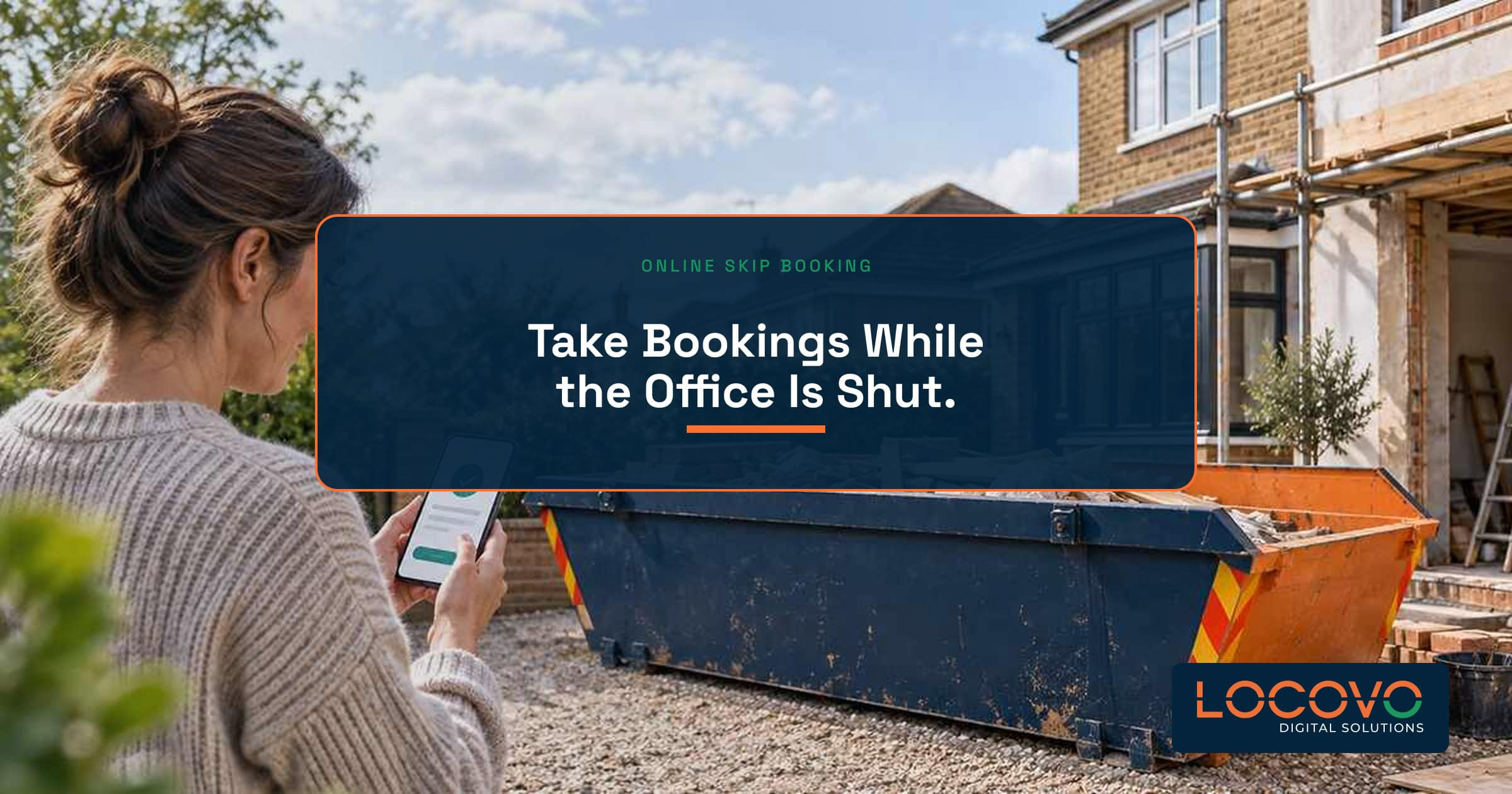
Customers do not stop looking for a skip when the office closes.
They search after work, compare prices on a phone and often book with the operator that gives them a clear answer first. An online skip booking system can capture that demand. It can also create a queue of unusable orders if the journey asks the wrong questions.
The goal is not merely to take payment. It is to create a booking the operations team can actually deliver.
Help the customer choose without making them an expert
Most domestic customers do not think in cubic yards. They think about a bathroom rip-out, garden clearance or pile of household waste. Give practical size guidance, clear dimensions and examples without promising that every load will fit.
Make prohibited and restricted materials obvious before checkout. Hiding the rules in small print produces awkward calls, rejected loads and arguments at collection.
Check the delivery postcode early
There is little value in guiding somebody through five screens before revealing that the business does not cover their area. Ask for the delivery postcode near the start.
Use it to confirm coverage and apply the right area price. If the location needs manual review, capture the enquiry cleanly rather than showing a dead end.
Ask the questions that affect delivery
An online form should collect operational facts, not everything the company might ever want to know.
- Delivery address and postcode
- Skip size and waste type
- Preferred delivery date
- Whether the skip will sit on private land or the highway
- Access limitations and placement notes
- Customer contact details
- Agreement to the relevant hire terms
Use conditional questions. A customer placing a skip on a driveway should not fight through irrelevant fields meant for a commercial construction site.
Do not sell dates the operation cannot honour
A calendar is not availability unless it reflects capacity. If the website accepts ten eight-yard deliveries for Monday while the yard has four units free, the online system has simply moved the difficult phone call to later.
Set sensible lead times, daily limits and cut-off rules. Keep manual approval for jobs that need permit checks, unusual waste handling or a site-access conversation.
A booking is only complete when the customer promise and the operational capacity agree.
Make the full price clear
Customers should understand what the displayed price covers, how long the standard hire lasts and which extra charges may apply. Surprises after payment damage trust and create avoidable office work.
Show area supplements, permit arrangements and waste restrictions at the point they become relevant. Plain language beats a long terms page nobody reads.
Design for a customer holding one phone
Most people will book on mobile. Keep fields large, choices clear and the number of steps reasonable. Address lookup should help without preventing manual correction. Error messages should explain what needs fixing.
Test the journey on an ordinary phone with average signal. Watch somebody outside the business use it. The points they hesitate are usually more useful than another hour discussing button wording.
Send one clean order into operations
The strongest booking journey loses value if staff must copy every order into a spreadsheet. Customer, price, address, product and delivery details should reach the operational system together.
Give the office a clear review route for exceptions. Routine orders can move into planning; unusual ones can be checked before a promise is confirmed.
Measure good orders, not just conversions
Learn from abandoned bookings without chasing everybody
People leave checkout for plenty of reasons. The price may be wrong for them. They may need to check the driveway, ask a partner or compare another operator. An abandoned booking is not automatically a sales lead that wants three messages.
Use aggregated journey data to find friction: a postcode step that fails, unclear skip sizes, an unexpected supplement or a payment error. If you send recovery messages, make sure the marketing and privacy basis is properly handled and the customer can opt out.
The better win is often fixing the cause. Clearer waste guidance may prevent hesitation. Showing the delivery area earlier may remove dead-end journeys. A visible phone number at the right step can rescue a genuinely complex booking without forcing every customer to call.
A high checkout conversion rate means little if the team spends every morning correcting addresses and changing dates. Track cancellations, manual interventions, pricing errors and failed deliveries alongside sales.
Locovo connects online ordering with postcode pricing and the wider Dashboard workflow, including WooCommerce-based booking setups. See the Locovo Dashboard if you want website orders to arrive ready for the people running the day.